You find a really cool text style.
You change your normal brand name from:
Fancy Brand
to:
𝑭𝒂𝒏𝒄𝒚 𝑩𝒓𝒂𝒏𝒅
And suddenly, it feels different.
A little more creative. A little more personal. Maybe even more noticeable.
That’s why people use stylish text for Instagram bios, gaming usernames, social media captions, promotional posts, and personal branding.
But here’s something worth thinking about.
What if your stylish brand name looks completely different on someone else’s phone?
What if a customer can’t read an important offer because every word is decorated?
Or what if a screen reader struggles to communicate the text properly?
That’s where responsible styling becomes important.
Using stylish fonts ethically means making your content readable, accessible, honest, and suitable for the people you’re trying to reach.
You can absolutely make text look different.
Just don’t let the styling create problems for the person reading it.
Why Do Brands Use Stylish Fonts?
People naturally notice things that look a little different.
That’s one reason brands experiment with typography, colours, layouts, and decorative text.
A playful brand might want something fun.
A gaming creator might prefer something bold or unusual.
A beauty brand might want a soft, aesthetic look.
And a professional service might need something cleaner and easier to read.
There isn’t one text style that works perfectly for every brand.
For example:
Normal: New Collection Launching Friday
Styled: 𝐍𝐞𝐰 𝐂𝐨𝐥𝐥𝐞𝐜𝐭𝐢𝐨𝐧 𝐋𝐚𝐮𝐧𝐜𝐡𝐢𝐧𝐠 𝐅𝐫𝐢𝐝𝐚𝐲
Both communicate the same message.
The styled version adds visual emphasis.
But styling alone doesn’t make the message better. The words, context, visuals, and overall brand identity still matter.
A good text style should help people notice and understand your message, not distract them from it.
First, Stylish Unicode Text and Actual Fonts Aren’t the Same Thing
This is something a lot of people don’t realise.
When you use a fancy text generator, you’re usually not downloading or installing a new font.
The generator often replaces ordinary letters with different Unicode characters that look bold, script-like, or decorative.
For example:
Normal: Hello Brand
Bold Unicode: 𝐇𝐞𝐥𝐥𝐨 𝐁𝐫𝐚𝐧𝐝
Script Unicode: 𝓗𝓮𝓵𝓵𝓸 𝓑𝓻𝓪𝓷𝓭
These styles use different characters, not simply a different typeface applied to normal letters.
The Unicode Standard defines characters that computers can represent, while fonts determine how supported characters appear visually.
Why does this matter for branding?
Because copy-and-paste Unicode text isn’t the same as professional brand typography.
If you’re designing an official logo, packaging, website, or advertisement, choosing an actual typeface gives you more control over appearance, spacing, readability, and consistency.
You’ll also need to check that the font’s licence permits your intended commercial use.
For a social media bio or decorative heading, Unicode-based stylish text may be useful.
For a permanent brand identity, properly selected and licensed typography is usually the more reliable choice.
1. Keep Your Text Readable
Let’s say you’re promoting a new collection.
You write:
- 𝐍𝐞𝐰 𝐂𝐨𝐥𝐥𝐞𝐜𝐭𝐢𝐨𝐧
- Launching Friday
- Shop Now
The heading stands out, while the rest of the information remains easy to read.
Now imagine the entire advertisement uses a heavily decorated style.
The brand name is fancy.
The product description is fancy.
The price is fancy.
Even the instructions are fancy.
At that point, the decoration can become distracting.
Someone shouldn’t have to spend extra time figuring out what your advertisement says.
A simple rule: Use stylish text for emphasis, not for every word.
Short headings, names, or decorative phrases may be suitable places to experiment.
For longer descriptions, instructions, and important information, ordinary readable text is generally a better choice.
2. Think About Accessibility, Not Just Appearance
This is probably one of the most overlooked parts of using stylish Unicode text.
When you’re creating content for a brand, you’re not the only person who will read it.
Some people use screen readers.
Others may have visual impairments, reading difficulties, or devices that display characters differently.
Decorative Unicode letters can sometimes create difficulties for assistive technologies.
For example, a screen reader may announce certain mathematical-style Unicode letters by their individual character names rather than reading them like ordinary words. The exact behaviour depends on the screen reader, software, and configuration.
That can make a short sentence unnecessarily difficult to understand.
There’s also the issue of visual readability.
Highly decorated letters, unusual symbols, or extra marks can make some text harder to recognise.
So before using a style for important brand communication, ask yourself:
Would this still make sense to someone who doesn’t experience the text exactly as I do?
A few practical ways to improve accessibility:
- Keep important messages, prices, instructions, and contact details in ordinary text.
- Avoid writing long paragraphs entirely in decorative Unicode characters.
- Test how text behaves with assistive technologies when accessibility is important.
- Make sure the message still works without decorative styling.
You can also refer to the W3C Web Content Accessibility Guidelines when evaluating website content.
These guidelines don’t simply ban decorative text. They provide broader principles for making digital content perceivable, operable, understandable, and robust.
The goal isn’t to remove personality from your content.
It’s to make sure more people can understand it.
3. Don’t Use Stylish Characters to Mislead People
There’s another side to ethical text styling that has nothing to do with appearance.
Some Unicode characters look extremely similar to ordinary letters.
That means it’s possible to create names or words that visually resemble something else.
For example, two account names might appear almost identical even though they contain different underlying characters.
This can become a problem when someone uses lookalike characters to:
- Impersonate another brand or individual
- Make a fake account appear official
- Disguise suspicious links
- Misrepresent a company name
- Confuse people about who created the content
That’s not creative branding.
That’s misleading people.
A legitimate brand should make it easy for customers to recognise its actual identity.
If you’re using decorative text in your profile, keep your official name, website, and contact information clear.
Your styling should help people recognise you, not make them mistake you for someone else.
4. Never Hide Important Information Behind Decoration
Imagine seeing this offer:
𝐔𝐏 𝐓𝐎 𝟓𝟎% 𝐎𝐅𝐅
Looks exciting.
But what if the conditions are written in tiny, complicated text that most people won’t notice?
Or the actual offer applies to only a few products, but the advertisement makes it seem like everything is discounted?
The problem isn’t the fancy heading.
The problem is the way the information is presented.
Responsible branding means keeping important details clear.
For example, if you’re advertising a discount, customers should be able to understand the applicable products, conditions, and limitations.
The same applies to prices, product claims, refund information, and important instructions.
Stylish text can help people notice an offer.
It should never be used to make important terms harder to understand.
5. Choose a Style That Matches Your Brand
Not every brand needs the same visual personality.
A gaming creator might want something energetic and unusual.
A fashion page might prefer elegant, aesthetic styling.
A professional consultancy might want a cleaner presentation.
There’s nothing wrong with any of these choices.
The problem starts when the styling doesn’t match the message or audience.
For example, imagine a financial-services business using a highly decorative gaming-style name in every formal announcement.
It might attract attention.
But it could also make important information harder to read or create a mismatch with the brand’s intended presentation.
On the other hand, a gaming creator using the same style might feel completely natural.
That’s why context matters.
Before choosing a style, think about what you want people to feel when they see your brand.
Creative?
Professional?
Playful?
Elegant?
Energetic?
Then choose text styling that supports that identity.
Your brand’s personality should guide the style, not the other way around.
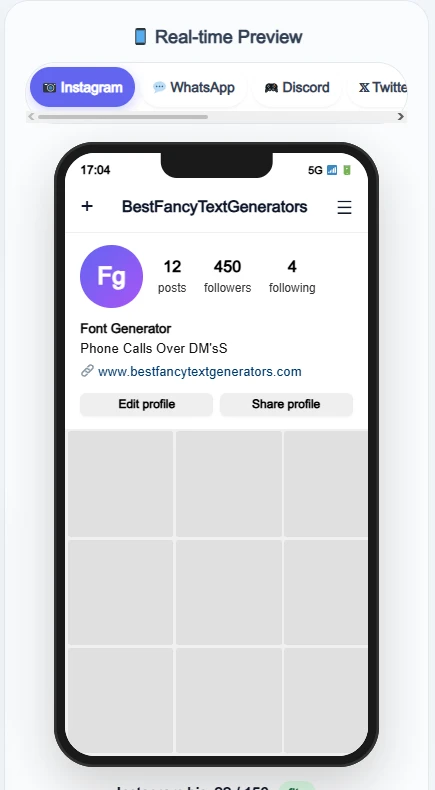
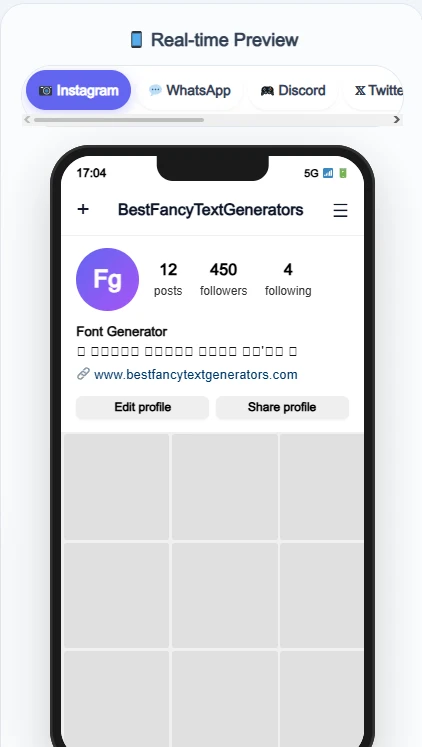
6. Check How Stylish Text Looks on Different Devices
One thing we learned while building BestFancyTextGenerators.com was that not every interesting-looking Unicode style behaves the same way everywhere.
Some characters looked good in one environment but didn’t render properly elsewhere.
Others displayed differently depending on the platform.
That’s because different devices, apps, browsers, and fonts don’t always display every Unicode character identically.
For personal use, a small visual difference might not matter.
For brand communication, consistency becomes more important.
Imagine your brand name looking great on your own phone but displaying missing characters on another device.
That can make your message difficult to recognise.
Before using decorative Unicode text regularly, test it in the environment where your audience will actually see it.
For example, if you’re creating an Instagram bio, check the pasted text inside Instagram rather than relying only on the generator preview.
If you’re preparing a caption, inspect the complete post.
And if the text is part of an important campaign, check it across the devices and platforms relevant to your audience.
7. Use Stylish Text Where It Actually Adds Value
Stylish Unicode text can be useful when it’s applied intentionally.
Here’s a simple way to think about common use cases.
| Where you’re using it | Recommended approach |
|---|---|
| Instagram bio | Use a short decorative phrase while keeping key information readable |
| Gaming username | Experiment with creative styles, subject to the game’s rules |
| Social media caption | Highlight a short heading rather than styling every paragraph |
| Promotional post | Keep offers, prices, and important conditions clear |
| Business profile | Prioritise recognisable names and easy-to-read contact details |
| Official logo | Prefer a suitable, properly licensed typeface and designed brand identity |
There isn’t one perfect style for every situation.
Something that looks great in a gaming profile might not work as well in a professional announcement.
And that’s fine.
The goal isn’t to use as many styles as possible.
It’s to choose the right one for the job.
How to Choose Stylish Fonts Responsibly?
You don’t need to become a typography expert to make better styling choices.
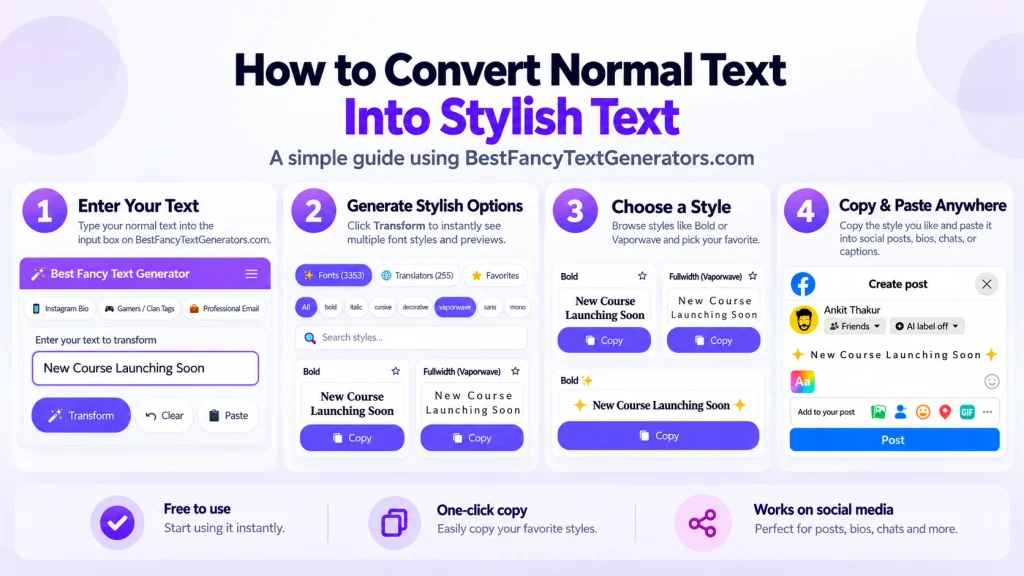
Here’s a simple process.
Step 1: Decide Why You Want to Style the Text
Are you trying to make a name stand out?
Highlight a heading?
Give your bio a particular personality?
Start with the purpose, not the decoration.
Step 2: Generate a Few Different Options
Open a Fancy Text Generator and enter the exact text you want to style.
Compare a few different options instead of picking the first one that catches your attention.
Step 3: Check Readability
Look at the text as if you’re seeing it for the first time.
Can you understand it immediately?
If you have to stare at the letters to figure them out, try something simpler.
Step 4: Check Whether It Fits Your Brand
Think about the audience and the situation.
A playful bio and an official customer announcement may need different approaches.
Step 5: Test the Actual Pasted Result
Copy the text and paste it into the platform where you want to use it.
Check for missing letters, unusual spacing, display differences, or character restrictions.
Step 6: Keep Important Information in Normal Text
If you’re communicating prices, conditions, instructions, contact details, or anything customers really need to understand, prioritise clarity.
Step 7: Review Accessibility
When practical, check how your text behaves with assistive technologies and whether the content remains understandable without decorative characters.
If everything looks readable, appropriate, and clear, you’ve probably found a suitable style.
What We Learned While Building BestFancyTextGenerators.com
The interesting thing about building our own fancy text generator is that the challenge kept changing.
It started with something pretty simple.
We wanted our names and profiles to look a little different.
So we searched for fancy text generators.
There were already plenty of websites, but after exploring several of them, we noticed that many offered similar styles.
We wanted more variety.
So we started looking at existing collections, searching for different Unicode combinations, and filtering styles that didn’t work properly.
Eventually, the collection grew to 2,000+ fancy text styles.
But then another problem appeared.
How do you help someone find the right style without making them scroll through thousands of options?
That’s where categories, search, and real-time previews became important.
And somewhere during that process, we learned an important lesson:
More choices don’t automatically make something more useful.
The same applies to branding.
You can have hundreds of fonts, symbols, and decorative options.
But none of that matters if the final message is confusing, difficult to read, or unsuitable for the audience.
That’s why we’ve always believed that the goal shouldn’t just be finding text that looks different.
It should be finding something that looks right for how you actually want to use it.
Frequently Asked Questions
Is Using Stylish Fonts in Branding Unethical?
No. Decorative text isn’t inherently unethical. Problems arise when styling misleads people, creates unnecessary accessibility barriers, hides important information, or impersonates another identity.
Can Fancy Unicode Text Cause Accessibility Problems?
Yes. Some decorative Unicode characters may be announced differently by screen readers or be difficult for certain users to read. It’s better to keep important messages in ordinary text.
Should Brands Use Fancy Text in Their Instagram Bios?
They can, but selectively. A short styled phrase may add personality, while normal text is usually better for important information such as services, contact details, and instructions.
Can Stylish Fonts Make a Brand Look Unprofessional?
They can if the style doesn’t match the brand’s audience or context. However, a suitable style used carefully can also strengthen a brand’s visual identity.
Is Unicode Fancy Text the Same as a Font Used in a Logo?
No. Unicode fancy text often uses alternative characters to create a decorative appearance. A professional logo typically uses designed lettering or a typeface with suitable usage rights.
Should I Use Fancy Text for Prices or Important Offers?
It’s generally better to keep prices, conditions, and important instructions in readable ordinary text. Decorative styling can be used for emphasis without making the details difficult to understand.
Can I Use Any Font Commercially?
Not necessarily. Actual typefaces can have different licences and usage restrictions. Check the font’s licence before using it for commercial branding, packaging, or other designs.
Final Thoughts
Stylish text can be a fun way to make a brand feel more personal.
It can help a name stand out, give a social media profile some personality, or make a short heading more noticeable.
And there’s nothing wrong with wanting your content to look different.
But good branding isn’t just about getting attention.
It’s also about making sure people understand what you’re saying.
Keep your important information readable.
Think about accessibility.
Don’t use lookalike characters to mislead people.
And choose styles that actually fit your brand.
While building BestFancyTextGenerators.com, we learned that a style being different doesn’t automatically make it useful.
The same lesson applies here.
Make it different. Make it yours. Just don’t make people struggle to read it.
Related Articles:
- How to Generate Fancy Text for Branding & Logos
- Are Fancy Fonts Legal for Commercial Use?
- How to Create Fancy Text Without Losing Readability
- Can Fancy Text Break Platform Guidelines?

Ankit Thakur is an SEO Specialist and WordPress Developer with 4+ years of experience. He has generated ₹60L+ in revenue through SEO, built 50+ websites, and helped businesses generate measurable leads through organic search and local SEO.