Imagine you’re designing a logo for your new clothing brand.
You find this really cool font online, download it for free, and use it in your design.
Everything looks perfect.
Then, just before launching, you notice something written on the font’s download page:
“Free for personal use only.”
Wait. Does that mean you can’t use it for your business?
And what about the fancy text generators that let you copy stylish letters directly into your Instagram bio? Do those have the same rules?
I used to think all these fancy-looking letters were basically the same thing. But after getting into Unicode text and eventually building our own fancy text generator, I realised there’s quite a difference.
So, are fancy fonts legal for commercial use?
Yes, many fancy fonts can be used commercially, but it depends on the font’s license and how you’re using it. Some fonts allow business use for free. Others require a commercial license. Fonts marked “personal use only” shouldn’t be used commercially unless you obtain permission or the necessary license.
Unicode fancy text is different because you’re generally copying characters rather than downloading font software. That usually avoids the need to license a particular font file just to copy those characters, but it doesn’t automatically clear every copyright, trademark, or platform-related issue.
Sounds a little confusing?
It’s actually easier once you understand the difference.
Fancy Fonts and Unicode Fancy Text Aren’t Exactly the Same Thing
People often use the words fancy fonts and fancy text as if they’re the same.
But technically, they can mean two different things.
1. Fancy fonts you download
Let’s say you’re designing a poster in Photoshop or Canva.
You find a font you like, download a .ttf or .otf file, and install it on your computer.
That’s actual font software.
A font file contains the information your computer needs to display characters in a particular typeface.
The creator or foundry may provide it under a license that explains what you’re allowed to do with the software.
For example, the license might permit personal projects but restrict commercial use, or it might permit commercial design work while limiting redistribution or embedding.
And that’s why downloading a font for free doesn’t necessarily mean you can use it however you want.
2. Fancy text you copy and paste
Now imagine you want your Instagram bio to look a little different.
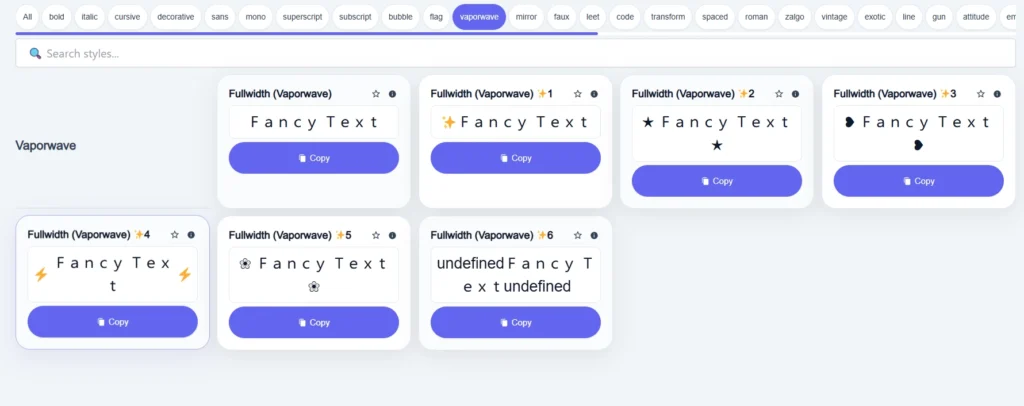
You open a fancy text generator, type your name, and get something like this:
- Normal text: Alex
- Fancy text: 𝓐𝓵𝓮𝔁
- Another style: 𝔄𝔩𝔢𝔵
- Another style: Alex
You copy one and paste it into your profile.
You’re not downloading a new font file. In these examples, you’re copying different Unicode characters.
Unicode is the system that assigns standard character identities to letters, numbers, symbols, and many other characters used by computers.
That’s why these styles can often be pasted into different apps without installing a matching font.
One thing worth knowing, though: Unicode doesn’t own every visual design of every character, and copying Unicode text doesn’t automatically give you permission to use someone else’s logo, artwork, or trademark.
What Does Commercial Use Actually Mean?
Let’s say you’re making a birthday poster for a friend.
That’s usually a personal project.
Now imagine you’re designing a poster for a company that’s paying you.
That’s commercial work.
Simple enough.
Commercial use generally means you’re using something for a business, professional, promotional, or revenue-generating purpose.
For example:
- Designing a company logo.
- Running paid advertisements.
- Creating packaging for products.
- Selling printed T-shirts.
- Designing websites for clients.
- Making templates that customers can purchase.
- Using typography in brand marketing materials.
But here’s something people sometimes forget.
You don’t necessarily have to sell the design itself for the use to be commercial.
A promotional Instagram post for your business can also count as commercial use.
So if a font license says “personal use only,” don’t assume that using it in a free social media post for your business is automatically allowed.
The actual license is what matters.
Can You Use Free Fonts for Commercial Projects?
Yes, some free fonts are available for commercial use.
But the word “free” can mean different things.
A font might be free to download, free for personal use, free for commercial use, or available under an open-source license with specific conditions.
Those are not all the same.
Here’s a quick comparison.
| Font license or description | What it generally means |
|---|---|
| Free for personal use | Commercial permission isn’t included unless separately granted |
| Free for commercial use | Commercial use is permitted within the stated terms |
| SIL Open Font License | Commercial use is allowed, subject to the license conditions |
| Paid commercial license | Commercial rights depend on the purchased license |
| No license information | Permission is unclear; verify before business use |
For example, imagine finding a handwritten font on a random download website.
The page says: “100% Free Download.”
That sounds great.
But after opening the license file, you discover it’s restricted to personal projects.
The download was free.
The commercial rights weren’t.
That’s why I’d always check the actual license before using a downloaded font in business work.
Are Google Fonts Free for Commercial Use?
Yes. This is one of the easiest options if you’re looking for fonts for a business project.
According to Google Fonts’ official developer documentation, the fonts in the Google Fonts collection are released under open-source licenses and can be used for commercial and non-commercial projects.
So you can generally use appropriately licensed Google Fonts for things like:
- Business websites.
- Company logos.
- Advertisements.
- Posters and brochures.
- Social media graphics.
- Client projects.
- Product packaging.
Pretty useful, right?
But you should still look at the license associated with the particular font, especially if you’re modifying or redistributing the font software.
Commercial use being allowed doesn’t mean every possible action involving the font file has no conditions.
What about the SIL Open Font License?
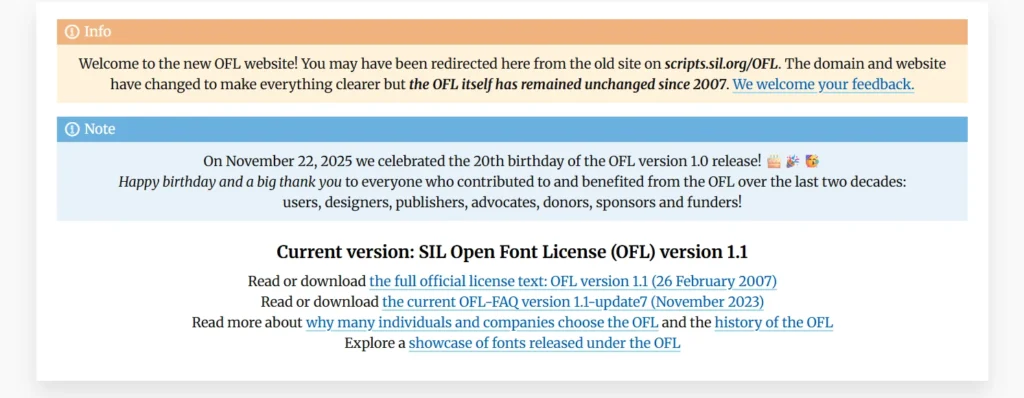
The SIL Open Font License, often called OFL, is a popular open-source font license.
It generally allows fonts to be used in commercial designs, including logos, printed materials, and software projects.
It also permits modification and redistribution under certain conditions.
For example, OFL font software generally cannot be sold by itself, and redistribution or modification may come with requirements such as keeping license notices or respecting reserved font names.
If you’re only using an OFL font to design a poster or logo, that’s different from packaging and reselling the font file itself.
You can read the license and its explanations on the SIL Open Font License website.
Are Adobe Fonts Allowed for Commercial Use?
If you’ve used Photoshop or Illustrator, you’ve probably come across Adobe Fonts.
Adobe’s official licensing documentation allows commercial use of fonts activated through Adobe Fonts under its terms.
That includes many common uses such as logos, printed designs, advertisements, and client artwork.
But there are still rules.
For example, under Adobe’s documented licensing terms, a client who receives finished artwork may not need their own font license just to use the finished graphic.
However, if that client needs to open an editable file and work directly with the font, they may need their own access or license.
Adobe also distinguishes ordinary merchandise design from products that allow customers to select and apply font files themselves.
So a font being commercially licensed doesn’t necessarily mean you’re allowed to redistribute it or build a font-based design service using it.
You can read the details in Adobe’s official font licensing FAQ.
How to Check Whether a Font Is Free for Commercial Use?
Okay, imagine you’ve found the perfect font for your brand.
Before adding it to every poster, website banner, and product design, here’s what I’d check.
Step 1: Find the original font source
Try to find the font creator’s website, the official foundry, or a trusted font library.
A random download website might not display the complete or latest licensing information.
Step 2: Look for the license
Check the font’s download page or included files.
Common file names include:
LICENSE.txtOFL.txtREADME.txtEULA.pdf
An EULA is an End User License Agreement.
Sounds super formal, but it’s basically the terms explaining what you’re allowed to do with the software.
Step 3: Look for commercial-use permission
Check whether the license allows the kind of work you’re planning.
For example, a font licensed for printed graphics might have separate conditions for website embedding, app distribution, or editable templates.
Don’t rely on a vague statement like “free font” when the actual permission matters.
Step 4: Check whether you’re distributing the font file
There’s a difference between using a font to create an image and giving someone the actual font software.
For example:
Creating a poster using a licensed font: May be covered by the design-use permission.
Including the font file inside an app or downloadable template: May involve redistribution or embedding permissions.
Those can be treated differently under a license.
Step 5: Save a copy of the license
This is something I’d definitely recommend for client work.
Keep the license text, purchase receipt, or other proof of permission with the project files.
That way, if someone asks where the font came from later, you aren’t stuck trying to remember which website you downloaded it from six months ago.
And if the license still isn’t clear, contact the creator or foundry before using it commercially.
Can You Use Fancy Fonts in a Business Logo?
Usually, yes, if the license permits that use.
But logos deserve a little more attention than ordinary social media graphics.
Imagine you’re launching a clothing brand.
You choose a font, type your business name, and make a logo.
If the font’s license permits commercial logo creation, that’s a good starting point.
But you also need to think about trademark rights and whether the final design is distinctive enough for your brand.
Permission to use a font and ownership of a logo are two different questions.
Using a legally licensed font doesn’t automatically mean nobody else can use the same typeface.
It also doesn’t guarantee that your logo can be registered as a trademark.
Trademark rules depend on the relevant country, existing marks, and the overall design.
For a business you plan to build seriously, it’s worth checking those issues before finalising the logo.
What about Unicode fancy text in a logo?
Technically, you can arrange Unicode characters into a logo-like design.
But I wouldn’t automatically recommend that for a professional brand identity.
Here’s why.
A Unicode character can appear differently depending on the font or device displaying it.
If you’re creating a company logo, you probably want the exact design to look consistent everywhere.
Packaging, websites, advertisements, store signs, and print materials should all follow the same visual identity.
That’s easier to manage with proper design files and suitable typography.
Also, Unicode characters don’t give you exclusive rights to a visual style.
So for a casual Instagram profile, decorative Unicode text can be fun.
For a long-term company logo, a properly designed brand asset is usually the better option.
Can You Sell T-Shirts, Mugs, or Other Products Using Fancy Fonts?
Yes, provided you have the rights needed for the particular design.
Let’s say you’re creating a T-shirt that says:
Stay Weird
And you want it in a really cool typeface.
If the font license allows commercial merchandise design, you can generally use it within those terms.
For example, fonts licensed under the SIL Open Font License can be used in commercial printed designs, subject to the license conditions.
Adobe Fonts also permits many ordinary merchandise uses under its applicable terms.
But don’t assume this applies to every font you find online.
A personal-use-only font could require separate permission.
And if your design includes someone else’s brand name, logo, or copyrighted artwork, the font license doesn’t give you rights to those elements.
What if I’m using Unicode fancy text?
If you type your own phrase using ordinary Unicode characters and place it on a product, you generally aren’t redistributing a downloaded font file just by using those characters.
But that doesn’t automatically settle every intellectual property question.
The words themselves, an incorporated logo, a copied artistic design, or a trademark could still matter.
It’s better to check the complete design rather than focusing only on whether the letters look fancy.
What About Fonts Used on Business Websites?
This is another area where licenses can be different.
Using a font in a poster is not always the same as using it as a web font.
When a website loads font files through CSS, the font software may be delivered to visitors’ browsers.
Some commercial font licenses have special conditions for web embedding, domains, page views, or self-hosting.
Others, including many open-source licenses, permit web use without the same restrictions.
Google Fonts, for example, offers open-source fonts for website use.
But if you’re using a font from a commercial foundry, make sure your license specifically covers the way you’re deploying it.
Don’t assume that having permission to use a font in Photoshop means you can upload its files to any website.
Do You Need a Separate Font License for Client Projects?
Not always.
It depends on the font’s license and what you’re handing over.
Let’s say you’re designing a restaurant menu for a client.
You have a properly licensed font and deliver a finished PDF.
That might be covered under your license.
But imagine the client wants the original editable design file and plans to keep using the font in future projects.
If they need access to the actual font software, they may need their own license.
Adobe Fonts explicitly discusses this distinction in its licensing FAQ.
For other fonts, the conditions may be different.
So if you’re a freelance designer, ask yourself two questions:
Am I delivering a finished design?
Or:
Am I also giving the client the font software or an editable project that requires it?
That difference can matter.
And it’s much easier to sort out before handing over the project than after the client has already started using everything.
What Happens If You Use a Font Without the Right License?
Imagine finishing a brand identity, publishing it everywhere, and later discovering that the font was restricted to personal use.
That’s not a situation anyone wants.
Depending on the license, local law, and circumstances, unauthorised use could lead to a request to purchase an appropriate license, remove the font, stop using it, or resolve a legal dispute.
The outcome isn’t automatic or the same everywhere.
But it’s a good reason to check permissions before using a font in a commercial project.
Paying attention to the license early is usually much easier than replacing typography across packaging, advertisements, and website designs later.
Why We Started Building Our Own Fancy Text Generator
When I first got interested in fancy text, I honestly wasn’t thinking about commercial licenses or professional typography.
I just wanted my name to look different online.
You know when someone has a cool Instagram bio or gaming username, and suddenly yours looks kind of boring?
That was basically the starting point.
I searched for fancy text generators and opened a bunch of websites.
But after looking through them, I kept noticing something.
Many tools had similar layouts, and a lot of the styles seemed to repeat.
If everyone is using the same few options to look different, what’s the point?
So we started researching more Unicode characters and style combinations.
But while building Best Fancy Text Generators, we realised that finding more styles wasn’t the only problem.
Some characters didn’t display properly.
Some combinations looked interesting but weren’t actually useful.
So we started filtering styles that didn’t work the way we wanted.
Eventually, the collection grew to more than 2,000+ styles.
And that created another problem: how do you find one good style without scrolling forever?
That’s why we added categories, search, and real-time previews.
The whole idea was to make it easy to find a style you like.
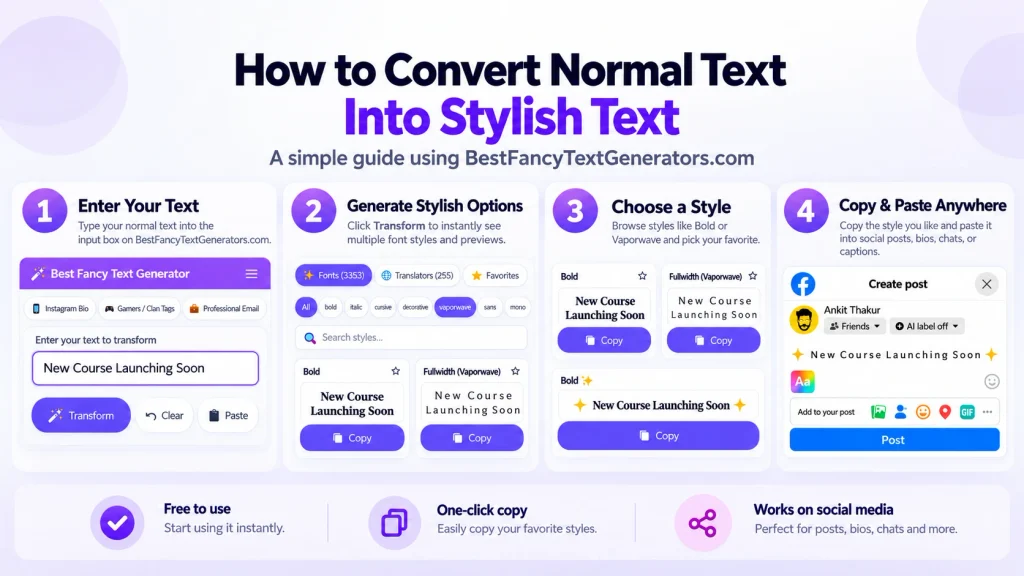
Type → Preview → Choose → Copy → Paste
That’s really it.
And learning more about Unicode text also helped us understand why these copy-and-paste styles are different from installing regular fonts.
Our experience was mainly about finding, testing, and organising Unicode styles. It wasn’t a legal review of every font or commercial license.
But it did teach us something useful: understanding what you’re actually using matters.
When Should You Use Fancy Text Instead of Regular Fonts?
I think the easiest way to understand this is to look at what you’re actually trying to create.
| What you’re creating | What I’d generally use |
|---|---|
| Instagram bio | Unicode fancy text |
| Gaming username | Unicode fancy text, if supported |
| WhatsApp status | Unicode fancy text |
| Fun social media caption | Unicode fancy text |
| Company logo | Licensed fonts and design tools |
| Product packaging | Licensed fonts and design tools |
| Business website | Fonts with appropriate web-use rights |
| Client branding project | Fonts licensed for the required use |
| Merchandise for sale | Font or artwork with appropriate commercial rights |
Fancy text is great when the goal is to make a small piece of text look different.
But if you’re creating something that needs consistent typography, print quality, brand control, or long-term commercial use, properly licensed design fonts are often more suitable.
And remember, fancy Unicode text can also behave differently across apps and devices.
Some stylised characters aren’t as easy to read, search, or interpret with assistive technology.
That’s another reason I wouldn’t use decorative Unicode characters for every part of a business website or important document.
Frequently Asked Questions About Commercial Font Use
Can I use a personal-use-only font for my business?
Not unless the font creator’s terms or a separate permission allow your intended commercial use.
If a font is marked personal use only, contact the creator or obtain an appropriate license before using it commercially.
Are all fonts from Google Fonts commercially usable?
Google states that fonts in its Google Fonts collection are released under open-source licenses allowing commercial and non-commercial projects.
Check the individual font’s license for conditions relating to modification or redistribution.
Can I use a free font on a product I’m selling?
Only if the applicable license permits that use.
A free download doesn’t automatically include commercial merchandise rights.
Can I use Unicode fancy text commercially?
Ordinary use of Unicode characters doesn’t generally require you to download or license a particular font file.
However, using Unicode text doesn’t automatically resolve trademark, copyrighted artwork, or other rights issues associated with your complete design.
Do I need to credit the font creator?
That depends on the license and what you’re doing with the font.
Some licenses require notices when redistributing font software, while ordinary use of the font in a finished design may not require visible attribution.
Read the actual license rather than assuming attribution is always required or always unnecessary.
Can I trademark a logo made with a free font?
Potentially, but font licensing and trademark registration are separate matters.
Whether the logo qualifies for registration depends on the relevant trademark rules and other factors, including existing rights and the distinctiveness of the mark.
Can I modify a commercial font?
That depends on the license.
Some licenses allow changes to the appearance of text in finished artwork but restrict changes to the actual font software.
Check the terms before modifying or redistributing font files.
So, Are Fancy Fonts Legal for Commercial Use?
Yes, many fancy fonts are legal to use commercially. But you need to know what type of font or text you’re using and which rights apply.
If you’re downloading a regular font, check its license.
If you’re using a font from Google Fonts or another open-source collection, verify the individual font’s terms.
If you’re making a logo, selling merchandise, designing a website, or working for a client, make sure the permission covers that specific activity.
And if you’re just using Unicode fancy text to make your Instagram bio or gaming name look different, you generally don’t need to install or license a font file just to copy those characters.
The important thing is not to confuse those two situations.
Honestly, when we started building our own fancy text generator, the goal was much simpler.
We wanted more ways to make our names look different.
And after researching thousands of styles, we realised that something doesn’t become useful just because it looks cool.
It needs to work for what you’re trying to do.
The same idea applies to fonts.
A font can look perfect for your project, but that doesn’t mean its license is perfect for your project.
So before using a downloaded font for business, check the rights.
And when you just want your words to look a little different, Unicode fancy text can be a quick, creative option.
Because making something look cool is fun.
Finding out you didn’t have permission to use it after you’ve already launched your brand?
Not so fun.
Note: This article provides general educational information, not legal advice. Font licenses and intellectual property rules vary by license, jurisdiction, and intended use. For important commercial or trademark decisions, review the applicable terms and seek qualified legal advice when necessary.
Related Articles:
- Ethical Use of Stylish Fonts in Branding & Content
- How to Generate Fancy Text for Branding & Logos
- Can Fancy Text Break Platform Guidelines?
- Is Unicode Text Safe for Social Media Platforms?

Ankit Thakur is an SEO Specialist and WordPress Developer with 4+ years of experience. He has generated ₹60L+ in revenue through SEO, built 50+ websites, and helped businesses generate measurable leads through organic search and local SEO.